A11y Pulse vs BrowserStack

BrowserStack if you live in the test cloud.
A11y Pulse if you don't.

BrowserStack's accessibility offering is a feature inside a real-device test cloud, economical if you already pay for cross-browser testing. A11y Pulse is the focused continuous-monitoring alternative for teams who don't.

What is BrowserStack?

BrowserStack started as a cross-browser testing cloud and has grown into a broader quality-engineering platform that covers automated testing, manual testing, app live-streaming, and more recently accessibility. The accessibility tier sits inside this larger product and shares the underlying real-device infrastructure.

Website Scanner Scheduled WCAG scans

Sitemap-driven scanning with deduplication, a score, and Jira integration. Closest piece to A11y Pulse in shape.

SDK + Workflow Analyzer CI-time + flows

One-line SDK install for CI checks. Workflow Analyzer for multi-step web and app journeys, including authenticated pages.

Real assistive tech NVDA, JAWS, VoiceOver

Real-device testing with actual NVDA, JAWS, VoiceOver on Mac and iOS, and TalkBack on Android. The piece A11y Pulse can't replicate.

Why teams switch to A11y Pulse

Three reasons to pick a focused monitor

BrowserStack's accessibility tier shines when you're already paying for the test cloud underneath. Outside that, three patterns push teams toward a focused tool.

1

Cost shape

Pay for what you'll use

BrowserStack's accessibility tier is most economical for teams already on the platform for cross-browser testing. Without that existing investment, you pay platform cost without getting platform benefit.

From $19 / month
2

Use-case fit

Production, not just the pipeline

BrowserStack's story is structured around test pipelines. Scans run when builds run, and the SDK ties results to a build artifact. Many accessibility regressions arrive through CMS edits and third-party scripts that never trigger a build.

Daily, between releases

3

Reporting shape

Stakeholder reports, not just CI output

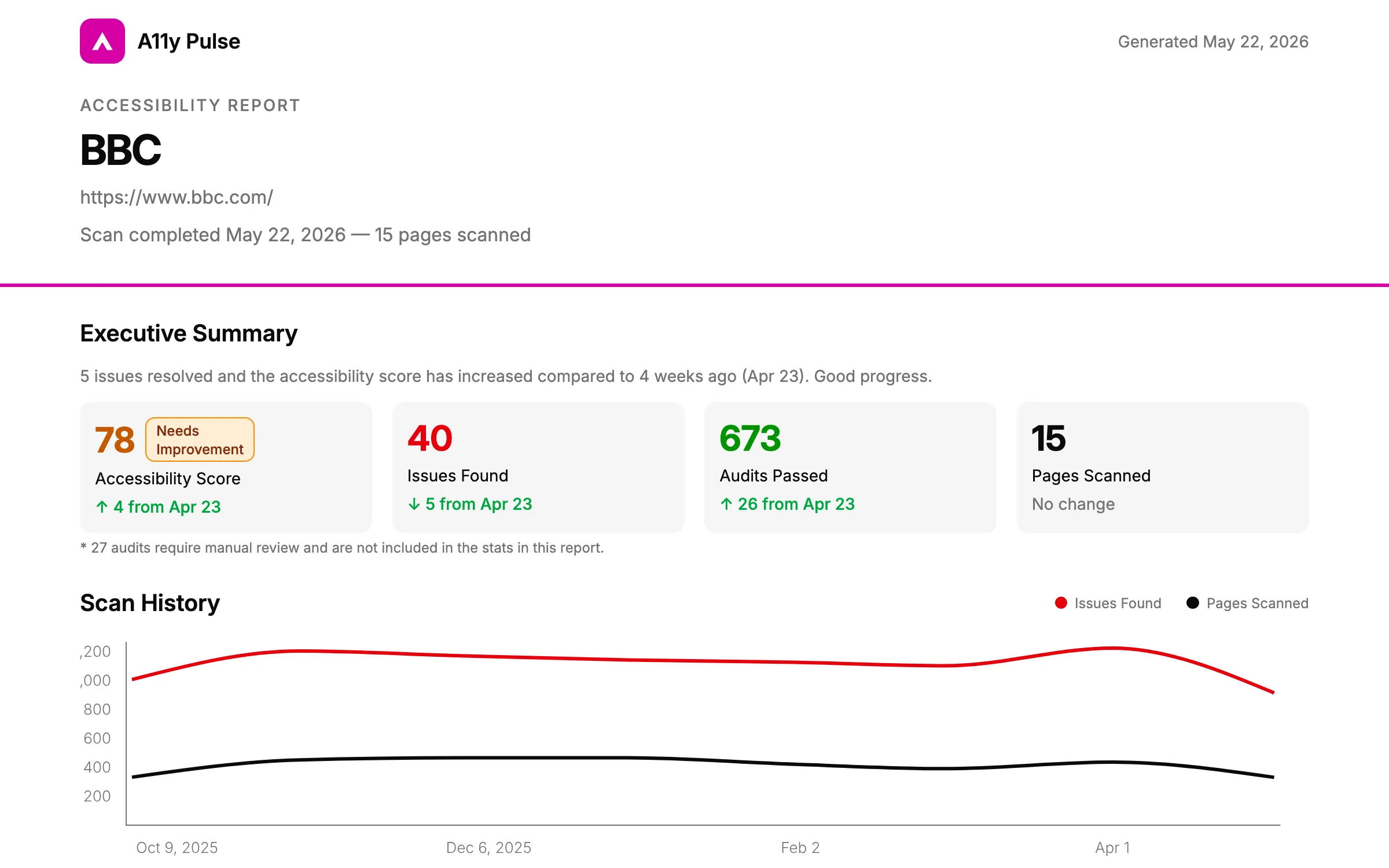
BrowserStack's output suits a QA engineer working a backlog. A monitoring tool produces the monthly email a non-technical stakeholder can read, with the latest scan compared against one from thirty days earlier.

Monthly delta + alerts

Where we fit

Continuous monitoring, without the test cloud

A11y Pulse handles the continuous-monitoring side of the workflow rather than the test-pipeline side. axe-core runs daily across your full sitemap, each page loads in real Chromium, and issues come into a dashboard shaped around triage rather than CI output. Slack and Teams alerts within hours of regression, the part the test cloud doesn't naturally cover.

  • axe-core daily across your full sitemap
  • Real Chromium for JS-rendered and authenticated pages
  • Email, Slack, and Microsoft Teams regression alerts
  • Monthly stakeholder reports comparing 30-day deltas
An A11y Pulse Slack alert reporting newly introduced accessibility issues across affected pages.

Side by side

A11y Pulse vs BrowserStack

Pricing
Trial
Testing engine
Real screen-reader testing
Native mobile app accessibility
Continuous site-wide monitoring
CI/CD integration
Authenticated + multi-step flows
Regression alerts
Stakeholder reports
Best for
A11y Pulse Continuous, site-wide
Recommended
$19, $49, $159 USD/month Published
Free, no credit card, instant
axe-core
Not offered
Not offered
Daily, primary use case
Not the primary use case
Scripted flow
Email, Slack, Microsoft Teams
Monthly email with 30-day delta
Teams not on the test cloud
BrowserStack Test cloud + accessibility
For comparison
Not directly visible Bundled with test cloud
Free trial via signup
axe-core With BS scoring + dedup
Yes NVDA, JAWS, VoiceOver, TalkBack
Yes, via real-device cloud
Via Website Scanner Secondary to CI
BrowserStack SDK One-line install
Workflow Analyzer + SDK
Jira, in-platform
In-platform reports
QA-led teams already on BrowserStack

BrowserStack accessibility pricing is not in static HTML and is typically packaged with the broader test cloud. Per browserstack.com as of May 2026.

Where A11y Pulse stops

The 30–50% number, on the homepage on purpose

A11y Pulse catches roughly 30 to 50 percent of accessibility issues automatically. That number is on the homepage because it's the truth, and any vendor claiming materially higher coverage from automated scans alone is being optimistic. The remaining 50 to 70 percent need a human to walk through the site, ideally one using assistive technology.

BrowserStack provides the infrastructure for that human work in a way A11y Pulse doesn't, and pretending otherwise would be a disservice to anyone reading this page. Real NVDA, JAWS, VoiceOver, and TalkBack on real hardware that testers can drive remotely is a serious capability pure-axe scanners can't replicate.

Most mature accessibility programmes are a combination: an automated scanner that watches the live site, an optional CI gate that catches regressions before they merge, and a manual screen-reader audit at meaningful release points. We built A11y Pulse to be the always-on layer that sits alongside whatever tool you choose for the manual side.

The verdict

When each tool is the right call

Choose

A11y Pulse

  • You're not on BrowserStack and don't need a real-device test cloud
  • Continuous monitoring matters more than CI-time scans
  • You want stakeholder monthly reports rather than developer CI output
  • You manage many websites and want predictable per-site pricing
  • Slack or Microsoft Teams alerts when production breaks fit your workflow
  • Published pricing matters to your buying motion

Choose

BrowserStack

  • You already pay for BrowserStack for cross-browser testing
  • Real screen-reader passes on NVDA, JAWS, VoiceOver, or TalkBack are part of your process
  • Native iOS or Android app accessibility is in scope alongside web
  • Your accessibility programme runs primarily inside CI/CD via a test SDK
  • Jira-first issue tracking and per-build artefact linkage are critical to your workflow
  • QA engineers, not content authors or marketers, are the primary tool users

Common questions

You asked.
We answered.

Still curious? Read the docs or email us.

No, and this is the most important answer on the page. BrowserStack offers real-device testing with NVDA, JAWS, VoiceOver on Mac and iOS, and TalkBack on Android, which is genuinely valuable and difficult to replicate. A11y Pulse is an automated axe-core scanner, which catches roughly 30 to 50 percent of accessibility issues. If real assistive-technology testing is on your critical path, BrowserStack is the better tool for that part of the workflow.

The information presented here about A11y Pulse and BrowserStack is provided for comparison purposes and may change over time. Pricing and feature claims about BrowserStack should be verified on their own website before making a purchasing decision.

The always-on layer, alongside whatever you use for the rest

14-day free trial, no credit card. Daily scans on your live site, Slack alerts the moment a regression appears.

Start your free trial