Operations
No server to keep running
Pa11y Dashboard needs Node, MongoDB, headless Chromium for SPA testing, a cron, and someone to upgrade all of it. A11y Pulse is the version where that operational tax is included in the price.
Five-minute setup
Pa11y is do-it-yourself open source software. A11y Pulse is the managed alternative for teams who want more detailed dashboards, better stakeholder reporting, and none of the operational overhead. Set up in five minutes, with reporting and alerts included.
Pa11y is a family of open-source projects maintained by the Pa11y team and released under LGPL-3.0. The CLI, the CI runner, and the self-hosted dashboard cover most of what a small team needs from automated accessibility testing, provided they have the appetite to operate a Node service and a MongoDB instance.
Point it at a URL, get accessibility issues printed to your terminal or written to JSON. Sensible per-page check before merging.
Runs pa11y against a list of URLs and produces consolidated output. The variant most teams reach for in CI.
Stores results in MongoDB, runs scheduled retests, graphs progress over time. Similar to A11y Pulse, but hasn't seen much active development recently.
Why teams switch to A11y Pulse
The Pa11y projects are free. The cost shows up everywhere else, in the server, the database, the missing alerting layer, and the time someone spends keeping it all patched.
Operations
Pa11y Dashboard needs Node, MongoDB, headless Chromium for SPA testing, a cron, and someone to upgrade all of it. A11y Pulse is the version where that operational tax is included in the price.
Five-minute setup
Continuity
Pa11y CI runs when code changes. Most accessibility regressions arrive through routes that don't trigger a build, like a CMS edit, a third-party script update, or a content upload. A11y Pulse watches between releases.
Daily, every page
Reporting
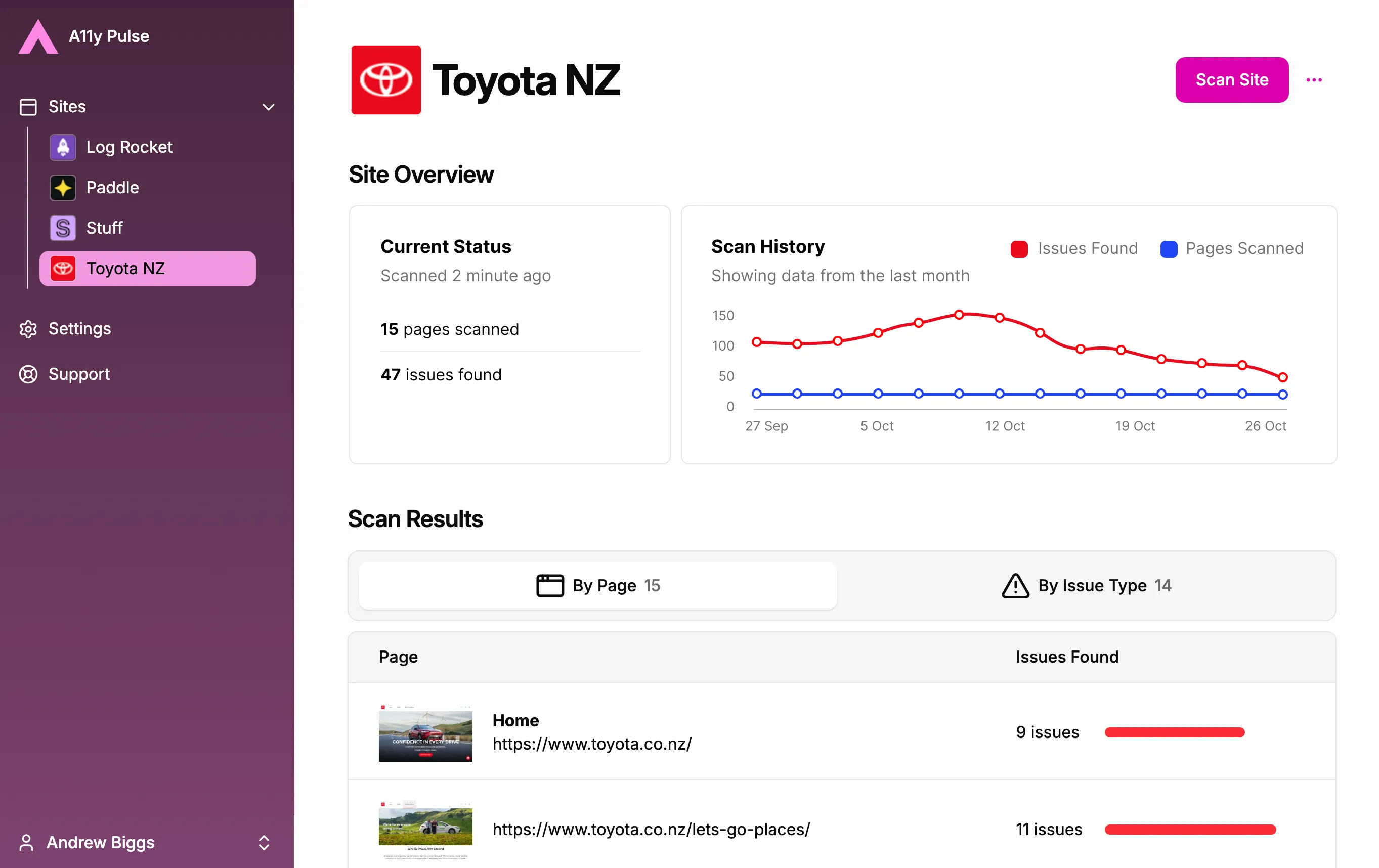
Pa11y Dashboard graphs issue counts. A11y Pulse does that, but adds monthly email digests, Slack and Teams alerts, and PDF reports your non-technical stakeholders can actually read.
Reports and alerts, built in
Where we fit
A11y Pulse runs axe-core daily across your full sitemap, so the underlying findings line up with Pa11y configured for axe. The difference is everything around the engine, including scheduling, multi-page coverage, history, deduplication, alerting, and the stakeholder report, that Pa11y leaves to you to build on top of the dashboard.
Side by side
Pa11y figures reflect the open-source projects at pa11y.org. Self-hosting carries server, database, and maintenance costs that vary by environment.
A note on the engine
If your sole requirement is "run axe-core against a URL", Pa11y does that for free. Both tools can drive axe-core; the underlying issue list for a given page should be substantially similar. The comparison isn't about the engine.
The comparison is about everything around the engine. Pa11y Dashboard graphs issue counts and runs scheduled retests, but multi-site reporting is light, alerting isn't built in, and there's no email digest format you'd send to a non-technical client. The patterns Pa11y leaves to you to build, alerting, multi-site rollups, stakeholder PDFs, deduplication across pages, are the patterns A11y Pulse ships with.
A common pattern in practice: keep Pa11y CI as a CI-time gate and use A11y Pulse for production monitoring. Pa11y catches regressions before they merge; A11y Pulse catches the rest. Your team only sees alerts for issues that made it into production.
The verdict
Choose
Choose
No. A11y Pulse is a hosted commercial product. The trade-off is that there is nothing to install, no Node.js version to manage, no MongoDB to back up, and no scheduled jobs to monitor. The accessibility testing engine A11y Pulse uses (axe-core) is open source and is the same engine Pa11y can be configured to run.
Yes. A11y Pulse loads each page in a real Chromium browser and waits for JavaScript to finish rendering before running its checks. Pa11y can also do this, but it requires extra configuration and you have to operate the headless browser infrastructure yourself.
If Pa11y is running with the axe runner against the same set of pages, the underlying issue list will be substantially similar because both tools delegate to axe-core. The differences come from how each tool prioritises issues, deduplicates them across pages, presents history over time, and notifies your team when something changes. Those are the layers built on top of axe-core, not the engine itself.
Yes, and we recommend this combination where the budget allows. Pa11y CI sits well in a pull request workflow as a fast pre-merge gate, and A11y Pulse covers the production monitoring side. That includes regression alerts, trend reports, and tests against pages and journeys that are awkward to script in CI. The two are complementary rather than mutually exclusive.
Pa11y itself is free, but Pa11y Dashboard needs somewhere to run. A small VPS or container plus a MongoDB instance is realistically $15-30/month, and you carry the operational cost of upgrading Node, axe-core, MongoDB, and the dashboard itself. A11y Pulse Starter is $19 USD/month with nothing to operate.
The primary use case for A11y Pulse is scheduled production monitoring rather than CI gating. Teams that want a CI-time check often keep Pa11y CI for that purpose and use A11y Pulse for the always-on monitoring. If you have a specific CI integration in mind, please get in touch.
A11y Pulse runs axe-core. Pa11y defaults to HTML CodeSniffer (htmlcs) and can be configured to run axe instead. The axe-core ruleset is the one we recommend standardising on because it's more actively maintained and is the engine that Lighthouse, axe DevTools, CWAC, and many other tools also wrap.
The information presented here about A11y Pulse and Pa11y is provided for comparison purposes and may change over time. Pricing and feature claims about Pa11y should be verified on their own website before making a purchasing decision.
30-day free trial. First scan tonight, no Node version to manage, no MongoDB to back up.
Start your free trial